Consulting

I promised a while ago that I’d blog about using a literary consultancy, and I’ve finally got some free time to do just that.

Writing is a very competitive business these days. Back when I first started looking for an agent last year, most of their websites apologised for the fact it would take them 4-6 weeks to respond; now they’re mostly saying 10-12. Some of them refer to the thousands of submissions they receive a year, or the hundreds a week, and that they can only take on a handful of new authors. A few agents suggested using a Literary Consultant to review your work prior to submission, and the most frequently mentioned name was Cornerstones so I visited their website and sent them an enquiry which included the first chapter and a synopsis of Alfie Slider at their request, they want to make sure that the writing is at a stage to benefit from feedback before going any further.

I quickly got an email back from Helen, who suggested which of their options would be best for me. Obviously there was a cost involved, but I felt that it was worth investing in my work and the fees were reasonable for the service provided. I chose to go ahead, paid my fee and was married up with a reader. I printed out and sent off my full MS, and tried not to think about it for the next few weeks!

Right on schedule I got an email which included a letter and the in-depth consultancy report I’d chosen. I was quite literally just leaving the house to go on holiday, so hurriedly printed it all out and got in the car. I read as I drove along, the covering letter was very complimentary and encouraging, there were happy tears. The full report seemed a bit more critical, there were sad tears.

When I read through it again a few days later, I noticed that what I’d thought was critical wasn’t really; it was useful. By the third read through I was feeling much more positive! I got a set of highlighters and went through the whole report again, I highlighted in pink for anything I’d done well, yellow for things to think about and green where there were issues that I could do something about right away.

Once I’d fully digested the report, I arranged a Skype call with the reader and emailed over my questions. We talked for about 45 minutes, and it was a great experience to have someone with industry experience chatting about my work. What really came across in the conversation that I hadn’t gleaned from the report, is that the publishing world has really changed. Whereas a few years ago a book like Alfie would have been snapped up quickly, in the more competitive market it had to be perfect and to fit all the marketing criteria; it had to be a money making machine. The editor suggested making Alfie a bit older, say 14, and doing a re-write to maximise my publishing potential.

At that point I cried a lot of tears. A lot. My bemused husband found me snot-sobbing on the sofa and asked me this sobering question: Are you really crying because someone wants your fictional character to grow up? I stopped crying.

I gave myself some time to think about it. I talked it over with friends. I asked myself the question: What am I prepared to do, to get published?

Ultimately, I decided to make Alfie a little older (he’s now in year 6 rather than year 4), but I didn’t feel that I knew enough about secondary schools, or the lives of teenagers to make him much older than that. 14 year olds have puberty and relationships to worry about, the structure of their school day is different and they have a lot more independence.

Whilst I understand that publishers want to maximise profit, I feel the best story that I can tell has Alfie at 10-11 years old. I know that the story has great appeal to kids in the 9-12 age group, because they’ve told me that. I know that slightly younger children love having the story read to them.

The whole exercise was really valuable in helping me identify some bad writing habits that I had, and to  look at my work more critically. It showed me how to lift it above ‘good enough’, how every word matters, how every sentence should shine. It also helped me to recognise the strong points of the work I’d done, and why I’d written the story.

I reworked the story in the light of the feedback and my own thoughts. I added in some new plot twists, I corrected mistakes and buffed even the dullest sentences to a shine. I’m now sending Alfie out to agents, it’s still a nerve wracking process but I feel much more confident doing it after getting my consultancy report.
Poetry

The first piece of my writing to be published was a poem. I was 8 years old and it was called ‘My Cat’. It was chosen for an anthology of poems by children and published by the local arts centre. The next year they ran the project again and my epic ‘Actor Mouse’ was selected. This early experience of literary success encouraged me, but the story bug soon ate the poetry one.

Other that studying Wordsworth and Owen in school for English Lit, I haven’t had a lot of exposure to poetry (except Pam Ayres, when she was on TV). I didn’t really think poetry was something to be enjoyed, but rather something that you looked on as an academic exercise, performing analysis on layers of meaning. Poetry was difficult.

When I started my Creative Writing course with York Uni last year, I wasn’t really looking forward to the poetry section of the module but I could see value in studying it; I hoped it help me to give my prose a bit of a lift, a more poetic feel. I found that, actually, I quite enjoy reading poetry. We went back to it for the next module, Critical Analysis; it’s outside my comfort zone, but I’m learning a lot as a writer from reading and writing poetry.

It’s still not my natural medium, though. When ideas come to me, they come in a rush with a huge volume of words behind them. Taking that and paring it down, carefully choosing exactly the right word not just for meaning but for music, is a skill that I don’t think comes naturally to me. Still, it does mean that sometimes now, when an idea comes that feels more like a poem than a story I don’t dismiss it.

That’s what happened last month with an Hour of Writes prompt. In or Out didn’t spark any interesting story ideas in my head but there was a poem. A pantoum; a fixed form poem that repeats lines from one verse in the next:

I have to ask one thing, I’ll keep it brief
My darling are you in or are you out?
At this point either answer is relief
Can’t live with this pervading sense of doubt

My darling, are you in or are you out?
To keep me waiting is the cruelest thing
Can’t live with this pervading sense of doubt
Is it a lie to keep wearing this ring?

To keep me waiting is the cruelest thing
The Sword of Damocles over my head
Is it a lie to keep wearing this ring?
Was truth held in the vows that we both said?

The Sword of Damocles over my head
A glimmer in your eyes makes hearts hope sprout
Was truth held in the vows that we both said?
My darling, are you in or are you out?

It got an overall mark of 65%, but the feedback was that it needed more work. I’d certainly agree. I was surprised to find out, last week, that it had been chosen as one of the featured entries for that week. I’m pleased, but feel a little undeserving (much as my 8 year old self did when My Cat was chosen).

The next module on my course is ‘Developing the skills of writing poetry’ so I hope that the next poetic offering I have for you will be a bit more polished. It’s good to go out of your writing comfort zone, try new things and add new skills to your writers toolbox.

Death of a Kingdom

As regular readers will know, I get a lot of support in my writing journey from my colleagues at York Writers. They’re a great group of people, very generous with their time and enthusiastic about writing in general. I’ve heard horror stories of writing groups that are set up by a writer or wannabe, who then expects others to do nothing but read and discuss their own work, or other groups where internal politics takes over and the environment is quite hostile. I consider myself very lucky to have such a great group on my doorstep, particularly because of the Novelist Support Group which, as the name suggests, is a group to encourage writers of longer pieces of work.

In the year and a bit I’ve been a member, it’s been a real pleasure to see the progress made by writers in the group; to learn about their stories, and see how they deal with problems that crop up. We might all be working in different genres and with different styles, but getting another view on your work from a fellow writer is really valuable and reading someone else’s work, seeing what they do that works well and what the particular issues of their genre are, is a great learning experience.

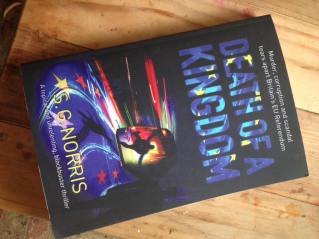
We share our frustration with the slush pile, encourage each other through rejections and celebrate each others successes. Which is what this post is really all about! I am delighted to be able to share a link with you to S G Norris‘ latest novel, Death of a Kingdom. It’s available in paperback and Kindle edition from Amazon. If you like political conspiracy novels you’ll love Steve’s work and this latest one is set against the backdrop of the EU Referendum so is nicely topical too! It is the third in a series, but if you haven’t read the others it won’t spoil your enjoyment of this one.

Steve

I’m looking forward to reading the final draft of what I know to be a great story; I hope you enjoy it too.

Oh, and the Sarah mentioned in the acknowledgements? That’s me, that is 🙂

Word Count

I spent an hour today sorting out the finished pieces of writing that I had, gathering them up from different Scrivener projects and saving them into the one I use to store and manage my shorter pieces of work; anything longer gets a project all of its own.

There were stories and poems that I’ve written for my Creative Writing course at York University, some of them had slipped my mind, and it was nice to reconnect with those ideas again.  Things written for particular competitions, and of course my entries for Hour of Writes. There are stories as short as 100 words, and some over 5,000 but by far my most common story length is 1500-2000 words.

Why? Well, firstly, most short story competitions ask for this word length. Secondly, it’s about the most I can write and edit to a reasonable standard in an hour so all my entries to Hour of Writes come in at that length.

There’s a pretty broad spectrum of subject matter. If I get an idea to write a story, then I write it; I don’t think ‘oh, I’m not a crime writer so I’ll forget about that idea!’ but because they’re my ideas, they tend to be about things that interest me. A lot of my stories I would describe as ‘dropping into someone’s head’; these are ideas that have come to me where I’ve had an idea for a character, or a situation, and when I write them the ‘story’ starts right in the middle of the action and doesn’t so much finish as reach a crisis point, move just past it and then end. I’ve written a few Fantasy pieces, but by far the largest genre represented in my work is Science Fiction.

I don’t, usually, write stories of space ships or stations, or battles with alien races. My stories tend to either be near future earth, dealing with the introduction of new technologies, or in an early period of colonisation following earth becoming inhabitable. There are enough of this latter category that I think I can bring them together into a novella or full length novel, when I get the time. I haven’t written any romance, horror or comedy. I wouldn’t say I’d never write them; I had a lot of fun writing a ghost story for NYC Midnight earlier this year, and I’ve dabbled a bit with the Gothic genre, but they’re just not the direction my thoughts usually run.

I suppose this is all a part of growing as a writer, experimenting with ideas, with genre, with style until I find the thing that is uniquely me; other than Alfie Slider, of course. I’m not sure if short stories are my thing though, my ideas tend to be too big and I’ve had a few people feed back that my shorter pieces read more like prologues to a longer piece, or leave them wanting to know ‘what happens next?!’ which isn’t ideal in a short story; received wisdom is that they should be self contained.

In total I have almost 47,000 words written in the last six months (on top of Alfie) and I’m proud of them. I think what is most surprising is that almost 30,000 of those come from Hour of Writes. In an hour a week (most weeks) and just over six months, I’ve got to a word count that is a respectable chunk of a novel. Now granted that doesn’t take all the thinking time into consideration; I only start writing once I have an idea that inspires me, but it’s still impressive, I think. If I could find an idea for a novel that inspired me, and took an hour or two a week to work on it, it could be done in a year…

Not that I have a shortage of writing projects on the go!  I’m working on the second Alfie Slider book, and I’ve started a new project, co-authoring a psychological thriller with a friend. I’ve had the time of my life learning how to craft a story over the last year, and I can’t wait to see what the next year is going to bring for writing.

Tylluan Valley Feedback

As part of the entry fee for NYC Midnight, you get to receive feedback from the three judges who read your piece and marked it for round one. I got the email with my comments in yesterday; they’re not as in depth as I might have hoped, but still useful. Each marker gave a comment on what they liked about the story, and what they felt needed improving. Here’s the feedback:

Marker 1
Liked – The narrator’s walk through the forest and slide that almost took him into the river contributes to a sense of foreboding that dissipates when he is mesmerized by the woman at the river and then accelerates when violent shrieking of a crow breaks the spell he was under watching the woman. The hostel and the warden are deliciously creepy.

Improve – The narrator’s guilt about drawing the woman seems a bit out of place because he was an artist. He didn’t have a purulent(sp) interest; he was compelled to draw her, and he didn’t appear to have any intention to exploit her.

So Marker 1 didn’t empathise with someone who felt bad about their voyeurism; on the other hand they enjoyed the pacing and sense of foreboding, the setting and the character of the warden.

Marker 2
Liked – I enjoyed the dreamlike voice and tone of this story. It’s a nice contrast against the dark turn it takes.

Improve – The narrator can be difficult to connect to at times. I wonder if there is a way to deepen his characterization so the reader can empathize with him more.

Marker 2 found it hard to connect with the story, and makes a good suggestion for an improvement. It’s feedback I’ve had before, I need to make sure the reader gets the same emotional connection with the characters as I do.

Marker 3
Liked – Wow! What a lovely story. There’s an old-fashioned feel to it, and the language is so stately. The narrator’s desire was palpable and his decision at the end was a perfect culmination of the story.

Improve – The story is perfect. There were a few instances where “there was” was overused. But that is a small nit.

Marker 3 is clearly an astute individual with great taste in literature 😉 Besides the very complimentary nature of this feedback, the marker connected with some of the main elements of the story from my POV as a writer; the ‘old-fashioned’ feel and stately language were a concious choice to give it a gothic flavour. The ending changed a few times over the week I wrote this story, so I’m glad that the final choice went down so well.

So, when I look at that feedback I can see that I’m not making any major mistakes. One judge marked it down because they didn’t understand the characters motivations, and that feels outside of my control. I can’t predict what attitudes a reader might have, only those of the characters. Marker 2 didn’t connect with the character, and that I can improve on. I need to detach myself from it and make sure there is a compelling reason for readers to feel the same way that I do about my characters. And Marker 3? Well, thank you. Your feedback was a real confidence boost.

So what’s next for Tylluan Valley? Well, I shall do some edits in the light of this feedback and then find another competition to submit it too.


NYC Midnight

I woke this morning to an email from NYC Midnight, telling me that the first round results were in. The email itself gave no clue as to how well you’d done, so with bleary eyes I clicked on the link, using the browser on my phone to see how my story, Tylluan Valley, had gone down with the judges.

I would’t say that I had high hopes; but I had hope. I wouldn’t have entered the competition if I didn’t think I had the talent to get past the first round, and I liked the story that I’d written. I’m not sure I could have done better under the competition conditions.

But…my name wasn’t in the top 5. I took a deep breath, already mentally consoling myself and putting a positive spin on things; then I noticed something. In addition to the five winners, there were three ‘honorable mentions’. Do you know who got one of those? Me!

NYC Midnight Result

Every entry gets individual feedback from judges, which should be with me in the next 48 hours. I’m really looking forward to getting that, and to see what I can do to improve for next time.

I enjoyed the competition. Like Hour of Writes, NYC Midnight stretches writers by giving them prompts and setting a time limit. For the first round my assignment was to write a ghost story, involving a scholarship student and a secret; trying to write a story that included these elements without being stereotypical was a challenge.

Ghost stories are not something I write (I don’t particularly enjoy reading them either) but that’s where the real lessons in writing are found, I think. When I’m in my groove, with Sci Fi or children’s stories, it all comes easily and I don’t have to think; the art and craft of it comes naturally. Take me out of that groove and it becomes trickier, and in the conscious choices I make I learn something.

So yes, I’m disappointed that I didn’t get to the 2nd round, I would have loved to have been part of that. I don’t regret entering at all; I’ve learned some lessons and I have a great short story to show for it.

The world had never been so empty. As I rounded the bend and saw the expanse of the valley spread out beyond and below me, my heart blossomed with the beauty of it. All the same, my instincts were complaining that this place was too big, too open, too lonely. (Tylluan Valley – Sarah Dixon)

Winning is very nice, but honorable mentions and valuable lessons are pretty great too. I’ve got my sights set on next year, though!

School Visit

When my children’s school said they were focusing on Science Fiction for Book Week this year, I had to get involved. I spoke to my son’s teacher and agreed to go in and read them a bit of Alfie Slider vs the Shape Shifter and answer any questions they might have about writing. I was quite nervous this morning; I’ve shared Alfie with a good number of people so far, fellow writers, beta readers, a literary consultant and of course agents but I’ve never read to such a large group before – and all of them my target audience! What if they all started yawning, or staring out the window?

I dressed for the part in a Doctor Who T shirt and a skirt with a space design. I felt more comfortable in a ‘costume’, I could pretend to be someone else a little bit. I got to school and the teacher asked if I would mind if three classes all came together to listen. From 30 children to 90! Yikes! I had about 20 minutes while the children were in assembly to prepare myself, so I sat down with my Kindle and went over what I was going to read.

I knew they were going to be working on the beginnings of stories later in the day, so I changed plans a little bit and read them the very first chapter and then skipped to the third, which is where Alfie looks at the mysterious key he’s found and starts to realise that it isn’t just a normal key. I had to take my glasses off to read from the Kindle so I couldn’t see their faces, but there wasn’t too much fidgeting and no talking, so I hope that they enjoyed it.

The teacher then asked them what they thought the key might open, and a lot of them had great ideas. A magic door, a transporter, different worlds, a space ship. They talked about the science part of the science fiction, about how Alfie realised that the key didn’t come from this world.

Then the very best part of the morning started, as I got asked lots of questions about Alfie and about writing. The children were absolutely brilliant, and asked really interesting questions.

I left floating on air! I was always a bit nervous about the idea of school visits, but now I’d love to do more of them. There is nothing like seeing a little spark of inspiration light inside a child’s eyes. I left with renewed enthusiasm to write some more.

I’m also going in to my daughters class soon (Reception) to read them a story that I’ve written especially for them about an alien visitor. I can’t wait!

Back to the Monkesto

Last year saw me writing Alfie Slider vs the Shapeshifter (Alfie 1) and starting the sequel, Alfie Slider and the Frozen Prince (Alfie 2). I got about 10 chapters into Alfie 2 when I got my Consultancy Report back from Cornerstones Literary Consultancy about the first manuscript, at which point I put it to one side to edit Alfie 1. I finished those edits at the tail end of 2015 and put the whole thing on the back burner until January.

The plan was to hit January hard. Submit the MS for Alfie 1 to agents, revise Alfie 2 in the light of edits to Alfie 1, and get the first draft finished. Then I learned two new words; Vestibular Neuritis. Having VN is as unpleasant as it sounds, my balance was shot to pieces and I felt like I was bobbing up and down on a boat most of the time. I couldn’t walk, ached all over, felt dizzy and sick and thinking was completely impossible. By the second week I could hold a thought, but couldn’t access my internal thesaurus. Any writing I did was a painful process of getting to the point where I needed a word and having to surf my way through thesaurus.com until I found the one I wanted. I had to prioritise my time to completing the Critical Analysis course I’m doing for part of my Creative Writing studies.

This week is the first time I’ve been able to actually do some work on Alfie 2. I could remember the overall plot, but had forgotten the details, and I wasn’t sure how big a job it would be to revise it after the chances to Alfie 1. I felt daunted at the idea of starting, so I did what I always do when I feel like that; I did it anyway. Within a few paragraphs, I was back there. Stood in the Monkesto, listening to Alfie chat with Mr Monk, smiling as the plot for this one unfolds and the story world expands.

I love Alfie, Amy, Mr Monk and all the other characters in the book. They don’t feel like things I’ve created, they feel like people and places I go and visit in my imagination. When I’m in the swing of writing Alfie, I don’t have to reach; I know just what he’d do or say, I know what’s behind the door they haven’t opened yet and what’s going to happen when they do. It’s a strange feeling, channeling these experiences from the world of imagination onto a computer screen.

Last week, in my continued search for agents, I came across one who has a particular interest in Sci Fi. I’ve sent him my submission information and now comes the long wait to see if I’ve found the person who sees the magic in Alfie and wants to help me take it forward.

Fingers crossed.

Taking Criticism

I get critique at any opportunity I can. It’s terrifying but I can’t learn or change without it so, needs must. If a writing competition offers critique, I will take it. This week I got an email about a short story that I’d entered into the last Henshaw’s Short Story Competition. This is the critique I got:

The Judges thought that though the story idea of breakdown in relationships ending in murder was not particularly new it had been given a clever twist here. But they thought that the twist at the end, whilst original, had given the events, characters and hence the story a lack of credibility.

The start was good, with a fast pace that gained the interest of the reader and made them want to read on. This fast pace was maintained by a good continuous storyline and retained attention throughout. The main character was well developed and provided a strong core for the story. Good use of dialogue also helped the reader relate to the main character and want to know what happened to her.

The writing was good, the conversations felt realistic and the main character was strong and convincing however the character of Juliet was undeveloped and would have benefitted(sp) from further development to make her later actions credible. The smooth creation of the scenario was effective and the atmosphere was well conveyed in the writing.

Overall the Judges thought that the story and in particular the character of Juliet was not credible and that also Juliet being a main player in the story needed a more developed character. The writing however was very good. There was a good balance of dialogue and description that carried the reader through at a good pace making them want to read the end of the story.

So, the first time I read this, I interpreted it as ‘They hated the story. It’s awful. I might as well just throw it away and give up writing altogether because I SUCK!’

Then my husband asked me to read it to him, and when I did that I realised how many positive there were. ‘A clever twist’, ‘Good dialogue’, ‘main character was well developed’, ‘The writing was good’, ‘creation of the scenario was effective’, ‘atmosphere was well conveyed.’ The judges just had one problem with the story, really. They didn’t know enough about the character of Juliet, so when her (rather extreme) actions are revealed at the end, it didn’t feel real for them.

They’re right.

This story is a rather odd one for me, because it literally came to me in a dream. It is written exactly as the dream played out (with a cast including Martin Freeman and Julia Davis) in my slumbering brain. I tend to get a bit blinded sometimes by the way a story comes to me when I first think or write about it. It doesn’t occur to me that I can change it. The individual words, yes, they can be edited but there’s something inherently sacred about the concepts, and the way they are revealed. I am learning, now, to be more analytical. To look at a story and to think ‘is there a better way that I can do this?’

That’s what I need to do here. I need to go back to the story and look at the way it ends. Does it need to be so extreme and gothic? Might a gentler ending be more realistic? It would only mean changing a few paragraphs, but I have to fight a natural resistance to do it. If I decide I want to keep that ending, how can I change the story to overcome the credibility issues the judges above mentioned?

It’s this sort of in depth analysis that is really changing my work. Not the way I write, but the way I edit. Now, when I go back to a piece for second or third draft, I’m much happier to throw away ideas that aren’t working and try something else. It feels a bit brutal at times, but the finished stories are much stronger as a result. At least, I hope so.


The darkness is overwhelming

I’m currently working towards a Certificate in Creative Writing with the University of York (Lifelong Learning). It’s a distance learning course which suits be perfectly because I can work from home around my other commitments. I completed the Core module last year and am working on Critical Analysis this year.

Last week we were asked to write no more than 500 words in response to the prompt ‘The darkness is overwhelming…’ The first idea that came to my mind was not my usual sort of thing at all, but it was a strong idea and wouldn’t quit until I’d written it. It was pretty dark, though, and I didn’t want to make that the first thing I shared with my fellow students, so I wrote something else and submitted that instead.

This is the original piece; 500 words with minimal editing. I can’t see myself expanding on this in the future, so thought I’d share it with you, Dear Reader 🙂

Trigger Warning: Suicide

Continue reading